Many employers are still struggling to find available workers, but the labor market is loosening. At the same time, companies are balancing cost concerns — especially as interest rates remain elevated — with the need to entice employees.
Overall, labor market churn has decreased. The share of employees quitting their jobs has trended down for 18 months, and the rate of layoffs has stayed relatively low.
“We are committed and continue to hire,” Karen S. Lynch, the president and chief executive of CVS Health, said this week in an earnings call. “It’s a tight labor market, but we’ve been having very good success in hiring.”
Demand remains high for skilled workers.
“The competition for talent, especially the best talent, remains very, very strong,” said David Solomon, the chief executive of Goldman Sachs, during its latest earnings call. He added that during a recent search at the bank, which has gone through multiple rounds of layoffs this year, the company had received 260,000 applications for 2,600 available positions.
Companies are also increasingly vigilant of their labor and wage expenses.
During S&P Global’s recent call with investors and analysts, the company’s chief financial officer, Ewout Steenbergen, said it expected margins to improve starting next quarter thanks in part to “tight management of head count and other expenses.”
For Meta, which has ended a hiring freeze, a significant amount of hiring planned for 2023 will now happen in 2024, said Susan Li, the company’s chief financial officer.
And during the latest earnings call for Southwest Airlines, Tammy Romo, the carrier’s chief financial officer, said it was expecting “increased headwinds” in 2024, largely because of higher labor costs.
Amid worries that the labor tightness is increasing skill mismatches, many companies are beefing up their artificial intelligence abilities.
“We want to make sure that we harness that opportunity and make the right level of investments in A.I.,” said Gary Swidler, chief financial officer of Match Group, the online dating company that owns Tinder, Hinge and other services, during its most recent earnings call. “We’re still trying to calibrate what that means in terms of hiring.”
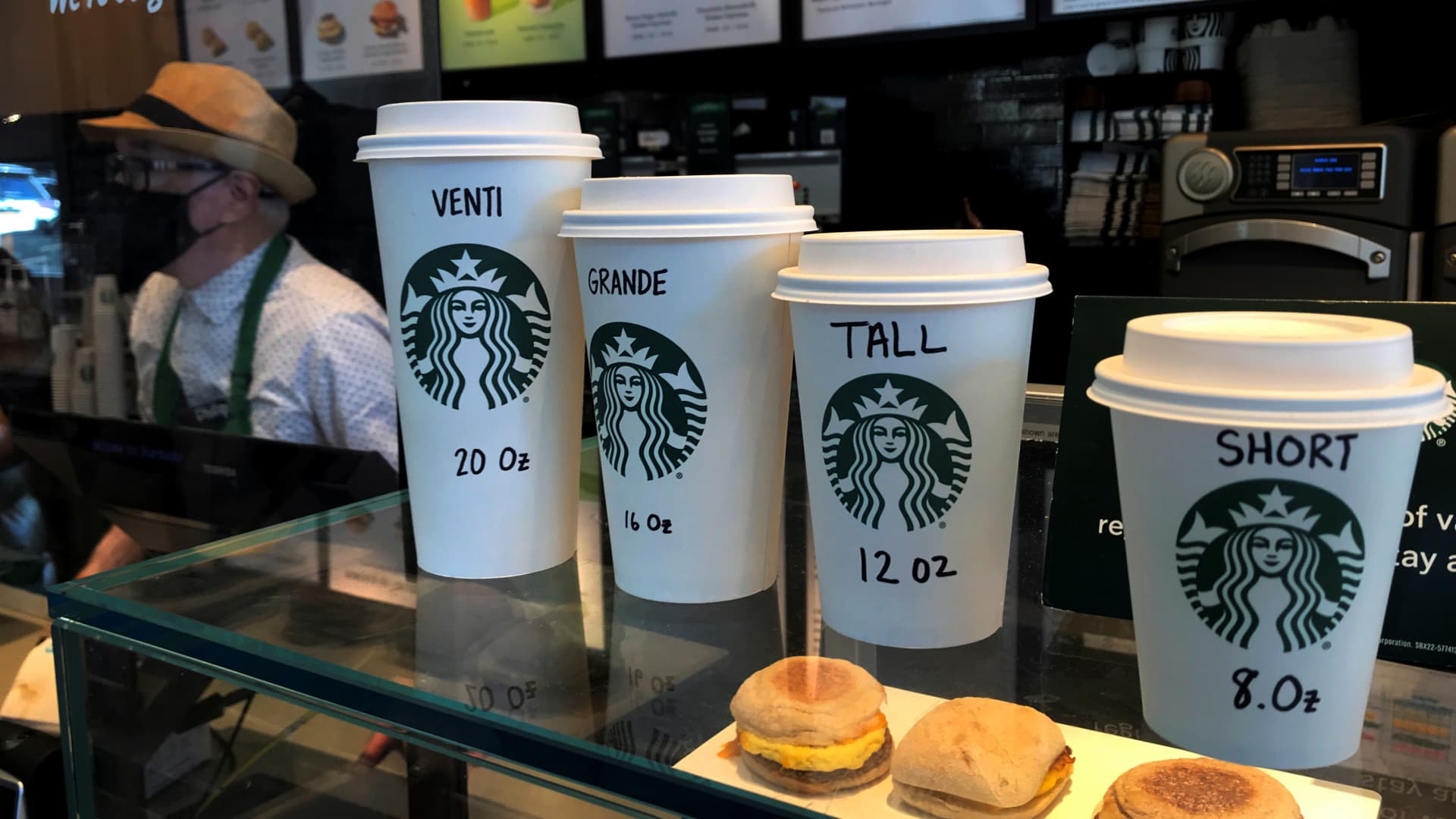
Starbucks cups are pictured on a counter in Manhattan, New York, on Feb. 16, 2022.
Carlo Allegri | Reuters
Starbucks on Thursday presented the latest stage in its plan to drive growth for the company, which involves accelerating its global footprint and saving $3 billion in costs over the next three years.
The company said it plans to expand to 35,000 locations outside of North America by 2030. Starbucks currently has roughly 20,200 international cafes, as of Oct. 1. In total, the coffee giant aims to reach 55,000 locations globally by 2030, up from its current count of more than 38,000.
"Three out of every four new stores over the near term is expected to be opened outside of the U.S. as our store portfolio becomes increasingly global," Michael Conway, president of Starbucks' international and channel development divisions, said during a company presentation.
Starbucks also announced a $3 billion cost-savings plan. Executives said $1 billion of those savings will come from making its stores more efficient. The rest will come from saving on its cost of goods sold.
The final piece of what Starbucks called its "Triple Shot Reinvention Strategy," announced Thursday, calls for wage increases for baristas, doubling their hourly income over fiscal 2020 earnings by the end of fiscal 2025. That jump will come from both increased hours and higher pay. Starbucks said it would share more details next week.
The announcement comes after more than 350 Starbucks locations have unionized under Workers United, according to National Labor Relations Board data. Starbucks and the union have not yet reached a collective bargaining agreement at any of those locations, and both the union and the NLRB have accused Starbucks of breaking federal labor law, including illegally withholding wage hikes at union stores. The company denies all allegations of union busting.
Momentum brewing
Earlier Thursday, the company reported its fiscal fourth-quarter results. Starbucks beat Wall Street's estimates for both its quarterly earnings and revenue, sending shares up 9.5%. The stock move reversed shares' losses earlier this year, giving the company a market cap of $115 billion, as of Thursday's close.
During the company's conference call, CEO Laxman Narasimhan said the company's "reinvention" plan unveiled last September is moving ahead of schedule, driving both sales and efficiency for Starbucks. For example, the chain's new single-cup drip coffee brewer is now installed in more than 600 locations.
More broadly, that plan takes aim at many of the issues plaguing Starbucks and baristas in recent years. Drink orders have grown more complicated and time intensive as cold beverages become more popular and Starbucks pushes pricey add-ons such as cold foam. Customers have also shifted to ordering their drinks through the company's mobile app and drive-thru lanes and expect their orders to arrive more quickly. Under that pressure, baristas have struggled to maintain speedy service and quality customer experience.
Former Starbucks CEO Howard Schultz unveiled the reinvention plan to simplify operations and improve both quality and speed of service more than a year ago. The strategy involves new coffee-making equipment and store formats plus more automation.
Schultz, then back at the company for a third stint in the top job, said Starbucks had made "self-induced mistakes" and lost its way. He stepped down from the role in March, handing the reins over to Narasimhan, a newcomer to the company who pledged to enact the plan.
At its investor day last September, Starbucks projected earnings per share growth of 15% to 20% annually over the next three years and annual same-store sales growth of 7% to 9%. The company's same-store sales outlook of 5% to 7% for fiscal 2024 falls short of that range, but the rest of its forecast for the next fiscal year meets those targets.
Prosecutors said Mr. Bankman-Fried had built his FTX crypto exchange into a “pyramid of deceit” while the defense said he was simply a “math nerd” who had no intent to defraud.
Sam Bankman Fried, the onetime cryptocurrency mogul, built his FTX crypto exchange into a “pyramid of deceit” resting on a “foundation of lies and false promises,” a federal prosecutor said on Wednesday at the criminal fraud trial.
Mr. Bankman-Fried’s lawyer countered that his 31-year-old client was simply a “math nerd” who may have made some bad business decisions, but had committed no crimes and never told anyone to break the law.
Those divergent messages formed the core of the closing arguments in Mr. Bankman-Fried’s trial on Wednesday in a Manhattan courtroom. Nicolas Roos, the prosecutor, began by saying that Mr. Bankman-Fried was a liar who was responsible for FTX’s collapse last year, which had left customers unable to recover their deposits.
Mr. Bankman-Fried, who had testified during the trial in his own defense, had “lied about big things and small things,” Mr. Roos said, pointing out that the defendant said he “couldn’t recall” more than 140 times in response to questions on cross-examination.
Then Mark Cohen, a lawyer for Mr. Bankman-Fried, said in his closing argument that the FTX founder had acted in good faith. “Time and again, the prosecution has sought to turn Sam into some sort of villain, some sort of monster,” he said.
Their dueling final arguments came after 15 days of testimony in Mr. Bankman-Fried’s trial, which is one of the most high-profile financial crime cases in years and has moved far more speedily than anticipated. The outcome of the case will be seen as a referendum not only on the rapid rise and fall of Mr. Bankman-Fried’s business empire, which at its peak was valued at $32 billion, but also on the volatile crypto industry, which only two years ago was riding high before melting down last year.
The spectacular implosion of FTX last November set off a chain reaction that led to the collapse of other crypto firms. Mr. Bankman-Fried’s arrest and subsequent charges also set off regulatory crackdowns across the crypto universe.
At the heart of Mr. Bankman-Fried’s case is whether he committed fraud and treated FTX as his personal piggy bank. Prosecutors contend that he stole as much as $10 billion from FTX’s customers to pay for investments in other crypto firms, buy lavish real-estate in the Bahamas, where the exchange was headquartered, and prop up a crypto trading firm he also founded, Alameda Research.
Mr. Bankman-Fried has pleaded not guilty to seven counts of fraud, conspiracy and money laundering. If convicted, he could face what amounts to a life sentence.
Carl Tobias, a professor at the University of Richmond School of Law, said the prosecution presented a strong case and made a smart decision in “framing this matter as a garden-variety fraud case, rather than a more complex cryptocurrency case.”
Mr. Bankman-Fried’s trial, which began on Oct. 4, has featured plenty of damaging testimony. Prosecutors called 16 witnesses, including three of Mr. Bankman-Fried’s former top lieutenants, each of whom had pleaded guilty to fraud and conspiracy charges and agreed to testify against their former boss. The defense, for its part, called just three witnesses, one of whom was Mr. Bankman-Fried.
At the trial, the prosecution’s three star witnesses — Caroline Ellison, Nishad Singh and Gary Wang, who all worked with Mr. Bankman-Fried — testified that the FTX founder knew for many months that his spending spree was unsustainable and improperly fueled by FTX’s customer money that had been transferred to Alameda. They also said Mr. Bankman-Fried knew Alameda could not pay back the billions that it had misappropriated from FTX, with Alameda’s debt to FTX concealed from customers and investors.
In response, Mr. Bankman-Fried and his lawyers argued that he was unaware until just a few weeks before FTX collapsed that billions in customer money had been misused. Mr. Bankman-Fried testified that he had thought Alameda’s spending came from corporate money, not customer money. Any mistakes that were made, Mr. Bankman-Fried said, were made in good faith and not intended to defraud anyone.
FTX was supposed to “move the ecosystem forward,” he testified at one point. “It turned out the opposite of that.”
For closing arguments on Wednesday, Damian Williams, the top federal prosecutor in New York, sat in the front row of the courtroom, accompanied by other government officials. Mr. Bankman-Fried’s parents, who have been fixtures in the gallery throughout the trial, skipped the government’s presentation but returned to the courtroom to see Mr. Cohen defend their son. Mr. Bankman-Fried sat between his lawyers, wearing the same gray suit and purple tie he wore on the stand in recent days.
Standing at the lectern, Mr. Roos went over the highlights of the testimony from the prosecution witnesses, including their statements that Alameda had special privileges with FTX, such as a $65 billion line of credit that permitted the trading firm to borrow billions from FTX’s customers. Mr. Bankman-Fried kept those special privileges secret, Mr. Roos said, “because he knew they were wrong.”
The prosecutor also went over the inconsistencies in Mr. Bankman-Fried’s testimony with those of his former employees. He displayed charts with headings like “The defendant’s lies to the public” and “The defendant’s false tweets in November.” He presented digital records that showed Mr. Bankman-Fried had looked at incriminating documents that he said he couldn’t recall having seen.
Mr. Roos also pointed out instances where Mr. Bankman-Fried appeared to deliberately use FTX’s customer deposits, including to buy back FTX equity from Binance, a competing crypto exchange.
Mr. Cohen began his closing argument by saying prosecutors went out of their way to focus on Mr. Bankman-Fried’s appearance. “We’ll agree there was a time when Sam was probably the worst dressed C.E.O. and had the worst haircut,” Mr. Cohen said, adding that those weren’t crimes.
The prosecution’s retelling of FTX’s collapse was exaggerated and cinematic, Mr. Cohen said. “In the real world, unlike the movie world, things can get messy,” he said, adding that the big spending by FTX and Alameda “were reasonable corporate expenses” and not a misuse of customer money.
Mr. Bankman-Fried acted in good faith with his business decisions and lacked the criminal intent to defraud anyone, Mr. Cohen said. It was the prosecution’s burden to prove guilt beyond a reasonable doubt, he added, and Mr. Bankman-Fried was not obligated to prove anything.
Mr. Bankman-Fried testified “because he wanted to tell you what happened,” Mr. Cohen said. “It is hard to think of a more stressful situation than that. He was far from polished. He was himself, he was Sam. He told you when he didn’t remember things.”
Mr. Cohen also tried to discredit Ms. Ellison, Mr. Wang and Mr. Singh. He displayed a chart showing that each of them could face decades in prison, and argued that they were acting out of self-preservation by cooperating with prosecutors.
As he finished his presentation, Mr. Cohen implored the jury to keep an open mind. He emphasized how quickly Mr. Bankman-Fried’s life had changed — a college student one day, a crypto mogul the next and now a defendant at a federal fraud trial.
As Mr. Cohen finished, Mr. Bankman-Fried looked close to tears. He blinked quickly, glancing back and forth from the lectern to his parents in the gallery. One of his lawyers put an arm around him, before a pair of U.S. marshals led him out of the room.
On Thursday, the jury of nine women and three men is expected to begin deliberating on a verdict after Judge Lewis A. Kaplan of U.S. District Court instructs them on the relevant law.
Disney is on the cusp of becoming the 100% owner of Hulu.
The media conglomerate announced that it expects to pay $8.61 billion to Comcast to acquire the cable operator’s 33% stake in Hulu following Comcast’s Nov. 1 exercise of its right under the put/call arrangement between the two companies. Disney owns the other two-thirds stake in Hulu.
“The acquisition of Comcast’s stake in Hulu at fair market value will further Disney’s streaming objectives,” Disney said in a statement Wednesday.
Under the terms of the sale arrangement, by Dec. 1, Disney said, it anticipates that it will pay Comcast approximately $8.61 billion, representing NBCUniversal’s one-third stake of the $27.5 billion guaranteed floor value for Hulu that was set when the companies entered into their agreement in 2019 minus the anticipated outstanding capital call contributions payable by NBCU to Disney of approximately $567 million.
But the deal is not officially done — and $8.61 billion might not be the final price tag Disney ultimately pays for the Comcast/NBCU stake in Hulu.
The two sides have been far apart on the question of Hulu’s market value. Comcast CEO Brian Roberts, at a Goldman Sachs conference on Sept. 6, touted Hulu as “a scarce, kingmaker asset” — and suggested an eyebrow-raising value. According to Roberts, the “synergies” Hulu would afford a full owner are worth $30 billion, even before accounting for the value of Hulu itself. “If you were selling all of this as is, there’d be a line of bidders around the block to actually buy all the content, all the bundling of Hulu,” Roberts claimed.
Hulu’s equity fair value is being assessed as of Sept. 30, 2023, by bankers enlisted by each side in accordance with the parties’ agreed appraisal process. (Comcast has tapped Morgan Stanley, and Disney hired JPMorgan Chase, per a CNBC report.) If the numbers calculated by Disney and Comcast’s bankers are not within 10% of each other, the two banking firms will pick a third firm to make another estimate, and Hulu’s final valuation will be the average of the two figures that are closest to each other.
"If the equity fair value is finally determined to be greater than the guaranteed floor value, Disney will pay NBCU an amount equal to NBCU’s equity ownership percentage of the equity fair value net of the guaranteed purchase price within 45 days of such final determination," Disney said in a filing with the SEC. "While the timing of the appraisal process is uncertain, we anticipate it should be completed during the 2024 calendar year."
In addition, according to Disney, under the terms of the transaction, the company will share with NBCU 50% of Disney’s estimated U.S. tax savings resulting from the acquisition of the Hulu stake, with payments expected to be made primarily over a 15-year period.
The long-held theory on Wall Street is that Disney has not expanded Hulu outside the U.S. so as not to increase its value — and thus keep a lid on what it would have to shell out to Comcast. Once it owns Hulu outright, Disney will be poised to launch it as a general-entertainment service worldwide.
Many Wall Street analysts are skeptical that Hulu is worth dramatically more than $27.5 billion minimum value the companies set in 2019, especially now that the gold-rush, grow-at-any-cost streaming era is over and replaced by a focus on profitability.
And Hulu's growth has cooled off. Subscriber growth in the second quarter of 2023 was 4.5%, a slowdown from 8% a year earlier, and Hulu gained just 100,000 total subscribers for the quarter ended July 1 to reach 48.3 million total (44 million on subscription-only tiers, and 4.3 million on live TV with SVOD plans). Disney is set to report earnings for the September 2023 quarter on Nov. 8.
Why is Hulu a long-term strategic asset worth retaining for Disney? The service will help the company's streaming bundles with Disney+ and Hulu reduce churn and boost pricing power, according to Morgan Stanley analyst Benjamin Swinburne. That's “key to scaling streaming revenues against a largely fixed cost base,” he wrote in a recent research note.
Denmark’s Orsted said it would be forced to write off as much as $5.5 billion as wind developers in the U.S. face wrenching financing costs.
Orsted, the Danish company that is a leading offshore wind farm developer, said on Wednesday that it would scrap plans to build two wind farms off the coast of New Jersey, forcing the company to write off as much as $5.6 billion.
The move was further evidence that offshore wind in the United States is going through a major shakeout, crimping Biden administration plans to make the industry a critical component of plans to reduce greenhouse gas emissions. High inflation and soaring interest rates are making planned projects that looked like winners several years ago no longer profitable.
“The world has in many ways, from a macroeconomic and industry point of view, turned upside down,” Mads Nipper, Orsted’s chief executive, said on a call with reporters on Wednesday. The two projects, known as Ocean Wind 1 and 2, were destined to provide green energy to New Jersey.
Offshore wind and other parts of the renewable industry have hit some snags in Europe, especially in Britain, but Mr. Nipper said the problems were more acute in the United States, because early contracts lacked protection from inflation and developers incurred high costs because of delays in approvals during the Trump administration.
The company’s stock price fell about 20 percent on Wednesday morning as the company reported a loss of about $3.2 billion for the third quarter and warned that the write downs — essentially, a reduction in the value of the company’s investments — would impact Orsted’s finances.
Orsted is writing off 28.4 billion krone, or about $4 billion, now. The company estimates that it may take another charge of up to 11 billion krone later in the year.
Orsted is not alone in encountering hazards in the fledgling offshore market in the United States.
On Tuesday, BP, the London-based energy giant, said it would write down $540 million on three planned wind projects off New York, after the state authorities declined to renegotiate their terms. BP says it is assessing future plans for the schemes in light of the decision.
In its announcement, Orsted said it would move forward with a $4 billion project called Revolution Wind intended to supply power to consumers in Rhode Island. And other developers have projects under construction, like Vineyard Wind, which will eventually have 62 turbines in the waters off Martha’s Vineyard, Mass.
Offshore wind is not dead, but the industry and its backers are certainly learning some harsh lessons. The ambitions of the Biden administration and states along the East Coast like New York, New Jersey and Massachusetts to install large amounts of clean electric power generation through offshore wind in the coming decades are likely to be set back.
The industry is dealing with equipment shortages as result of pandemic-era supply chain issues, and trying manage a growing number of orders for wind turbines as governments try to meet green energy goals. And escalating interest rates, as central banks around the world try to curb inflation, have caused financing costs to soar.
Consumers will also probably pay more in their electric bills for power generated from offshore wind, as developers demand higher prices and protection from inflation.
Mads Nipper, the chief executive of Orsted, in Copenhagen in March.Charlotte de la Fuente for The New York Times
Mr. Nipper said that rekindling interest in developing offshore wind off the East Coast depended on “a reset of what offshore power needs to cost.”
New York State declined in October to renegotiate existing offshore wind power contracts, but a subsequent auction awarded deals to supply power at significantly higher prices and with various provisions to protect the developers from inflation.
Still, there is little question that the confluence of challenges that Mr. Nipper characterized as a “perfect storm” is weighing down an industry that governments are counting on to produce large volumes of clean and relatively cheap electricity to tackle climate change.
Orsted has been both a pioneer and leading developer of offshore wind. After building the first offshore wind farm off Denmark in the early 1990s, the company has built up a global portfolio with projects in Britain, Poland and Taiwan as well as the United States.
Mr. Nipper said the company would be looking at various cost-saving measures including reshaping its portfolio. The company is likely to be more cautious in its investment plans, at least in the near term.
Orsted’s problems are not occurring in a vacuum. Siemens Energy, a large German maker of electric power equipment, recently said it was seeking government help to finance guarantees for orders and forecast large losses because of problems in its wind turbine unit, Siemens Gamesa.
In the case of Orsted, the write downs come largely as a result of the company’s decision to cancel a large project off New Jersey called Ocean Wind 1 that was well underway. Orsted also decided to scrub a sister project called Ocean Wind 2.
The write-offs will include investments the company has already made in building the project, payments to suppliers for goods already ordered or delivered and penalties for walking away from contracts.
ROSELAND, N.J., Nov. 1, 2023 /PRNewswire/ -- Private sector employment increased by 113,000 jobs in October and annual pay was up 5.7 percent year-over-year, according to the October ADP® National Employment ReportTM produced by the ADP Research Institute® in collaboration with the Stanford Digital Economy Lab ("Stanford Lab"). The ADP National Employment Report is an independent measure and high-frequency view of the private-sector labor market based on actual, anonymized payroll data of more than 25 million U.S. employees.
ADP Research Institute, logo (PRNewsfoto/ADP, Inc.)
The jobs report and pay insights use ADP's fine-grained anonymized and aggregated payroll data to provide a representative picture of the private-sector labor market. The report details the current month's total private employment change, and weekly job data from the previous month. Because the underlying ADP payroll databases are continuously updated, the report provides a high-frequency, near real-time measure of U.S. employment. This measure reflects the number of employees on ADP client payrolls (Payroll Employment) to provide a richer understanding of the labor market. ADP's pay measure uniquely captures the earnings of a cohort of almost 10 million employees over a 12-month period.
"No single industry dominated hiring this month, and big post-pandemic pay increases seem to be behind us," said Nela Richardson, chief economist, ADP. "In all, October's numbers paint a well-rounded jobs picture. And while the labor market has slowed, it's still enough to support strong consumer spending."
Private employers added 113,000 jobs in October Leisure and hospitality hiring led the post-pandemic job recovery. But the industry ceded its place as the top job creator last month to education and health care.
Change in U.S. Private Employment: 113,000
Change by Industry Sector
- Goods-producing:6,000
Natural resources/mining -1,000
Construction 4,000
Manufacturing 3,000
- Service-providing:107,000
Trade/transportation/utilities 35,000
Information 0
Financial activities 21,000
Professional/business services -10,000
Education/health services 45,000
Leisure/hospitality 17,000
Other services -1,000
Change by U.S. Regions
- Northeast: 21,000
New England 4,000
Middle Atlantic 17,000
- Midwest: -13,000
East North Central -17,000
West North Central 4,000
- South: 64,000
South Atlantic 34,000
East South Central 5,000
West South Central 25,000
- West: 46,000
Mountain 6,000
Pacific 40,000
Change by Establishment Size
- Small establishments: 19,000
1-19 employees 21,000
20-49 employees -2,000
- Medium establishments: 78,000
50-249 employees 96,000
250-499 employees -18,000
- Large establishments: 18,000
500+ employees 18,000
PAY INSIGHTS
Pay growth slowed to two-year low in October Job-stayers reported a 5.7 percent year-over-year pay increase in October, the slowest pace of growth since October 2021. Pay growth for job-changers was 8.4 percent, the smallest increase since July 2021.
Median Change in Annual Pay (ADP matched person sample)
- Job-Stayers 5.7%
- Job-Changers 8.4%
Median Change in Annual Pay for Job-Stayers by Industry Sector
- Goods-producing:
Natural resources/mining 5.3%
Construction 5.8%
Manufacturing 5.2%
- Service-providing:
Trade/transportation/utilities 5.5%
Information 5.1%
Financial activities 6.1%
Professional/business services 5.6%
Education/health services 6.3%
Leisure/hospitality 6.6%
Other services 5.9%
Median Change in Annual Pay for Job-Stayers by Firm Size
- Small firms:
1-19 employees 4.9%
20-49 employees 5.8%
- Medium firms:
50-249 employees 5.9%
250-499 employees 5.8%
- Large firms:
500+ employees 5.8%
To see Pay Insights by U.S. State, Gender, and Age for Job-Stayers, visit here:
* Sum of components may not equal total, due to rounding.
The September total of jobs added remained unchanged with no revision at 89,000. The historical data file, and weekly data for the previous month, is available at https://adpemploymentreport.com/.
To subscribe to monthly email alerts or obtain additional information about the ADP National Employment Report, including employment and pay data, interactive charts, methodology, and a calendar of release dates, please visit https://adpemploymentreport.com/.
The November 2023ADP National Employment Report will be released at 8:15 a.m. ET on December 6, 2023.
About the ADP® National Employment ReportTM The ADP National Employment Report is an independent measure of the change in U.S. private employment and pay derived from actual, anonymized payroll data of client companies served by ADP, a leading provider of human capital management solutions. The report is produced by ADP Research Institute in collaboration with the Stanford Digital Economy Lab.
The ADP National Employment Report is broadly distributed to the public each month, free of charge, as part of the company's commitment to offering deeper insights of the U.S. labor market and providing businesses and governments with a source of credible and valuable information.
About the ADP Research Institute® The ADP Research Institute delivers data-driven discoveries about the world of work and derives reliable economic indicators from these insights. We offer these findings as a unique contribution to making the world of work better and more productive by delivering actionable insights to the economy at large.
About ADP (NASDAQ – ADP) Designing better ways to work through cutting-edge products, premium services and exceptional experiences that enable people to reach their full potential. HR, Talent, Time Management, Benefits and Payroll. Informed by data and designed for people. Learn more at ADP.com
ADP, the ADP logo, and Always Designing for People,ADP National Employment Report, and ADP Research Institute are registered trademarks of ADP, Inc. All other marks are the property of their respective owners.