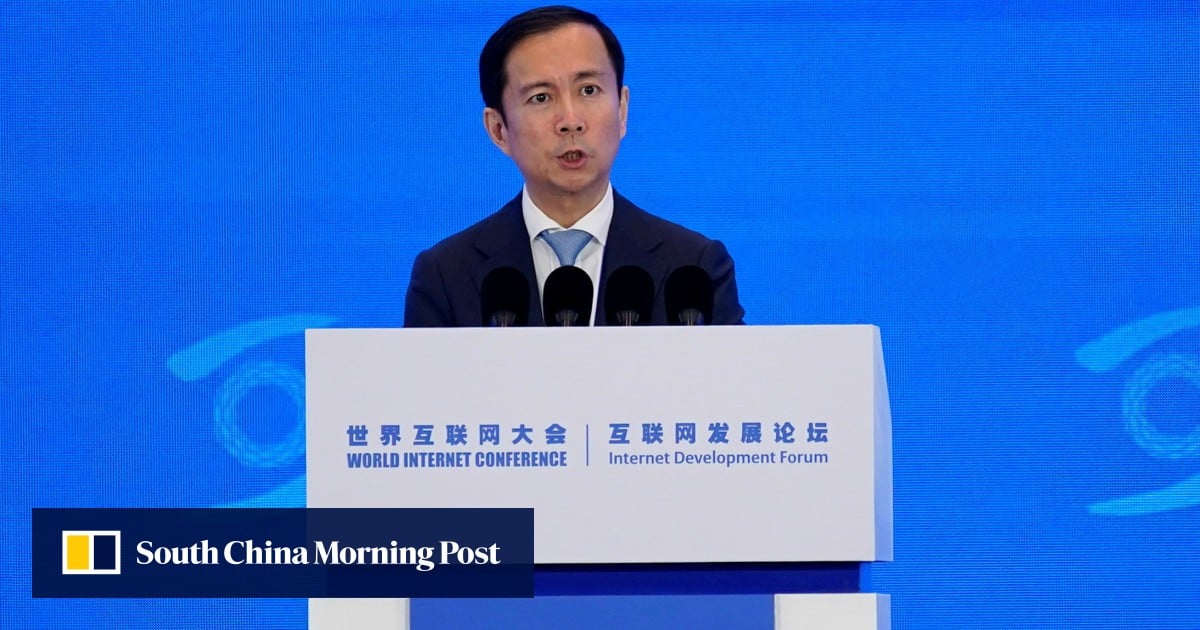
Former Alibaba Group Holding chairman and CEO Daniel Zhang Yong is stepping down as head of the e-commerce giant’s cloud division, a move that comes as a surprise the same day he was scheduled to hand the reins of the parent company to co-founder Joseph C. Tsai.
Alibaba’s new CEO Eddie Wu Yongming, who like Tsai assumed his new role on Sunday, has also taken over for Zhang as acting chairman and CEO of Alibaba Cloud Intelligence Group on the same day, according to an Alibaba spokesperson.
Alibaba, which owns the South China Morning Post, announced in June that 51-year-old Zhang would resign as Alibaba CEO and chairman, but would stay on as head of the cloud unit “given the importance of Alibaba Cloud Intelligence Group as it progresses towards a full spin-off”. Zhang took over as Alibaba CEO in 2015 and as chairman in 2019.
Shares of Alibaba Group slipped 2.8 per cent to HK$88.25 as of 9.45am local time, the most since August 18. The stock has gained 1.7 per cent this year, and advanced 3.5 per cent since June 20 when the group first announced the leadership transition.
“Four years ago, when [Alibaba founder] Jack [Ma] passed the chairmanship torch to Daniel, he set in motion our commitment to an institutionalised succession system that supports a sustainable enterprise for centuries,” said Tsai, who is also chairman of the Post, in an internal letter to Alibaba employees on Sunday. “Today, Daniel has entrusted that torch to Eddie and me under the continuity of our system for leadership succession.”
He also said the company decided it will “invest US$1 billion in a technology fund” established by Zhang. “The fund will support Alibaba’s strategy of investing for future growth and continuing to develop our technology ecosystem,” Tsai said, adding that Alibaba Partnership will give Zhang the distinguished title of “Aliren Emeritus”, a first for the company.
Advertisement
Alibaba “will continue to execute its previously announced plan to spin off Alibaba Cloud Intelligence Group under a separate management team to be appointed”, the spokesperson said.
Energy Secretary Jennifer Granholm looks at electric vehicles during a visit to the Washington Auto Show in Washington.Andrew Harnik/AP
The US Secretary of Energy went on a road trip to promote electric vehicles.
Jennifer Granholm and her team ran into a predictable snag: a lack of EV chargers.
The obstacle even caused the police to get involved at one point in the trip, NPR reported.
When the US Secretary of Energy and her team embarked on a road trip to promote electric vehicles, they ran into a predictable yet frustrating obstacle: a lack of electric vehicle chargers.
The scarcity of chargers was such an issue for Energy Secretary Jennifer Granholm and her team that the police got involved at one point, NPR reported.
The caravan of electric vehicles heading from Charlotte to Memphis over the course of four days hit a snag in Grovestown, Georgia. The group was planning a quick charge when they realized there wouldn't be enough electric vehicle chargers to go around since one was broken and the others were in use, NPR reported.
So an employee from the Department of Energy tried to save one of the spots using a gas-powered car.
It was a sweltering day and the move didn't go over well with a family that was also waiting for a charging spot. The situation escalated to the point that the family, driving with a baby in their car, called the police, who didn't have the authority to act because blocking an EV charging spot with a gas-power car isn't illegal in Georgia, NPR reported.
While Granholm and her team worked to smooth things over, ultimately ceding a spot to the family and relegating some of their own vehicles to slower charging ports, the incident drew attention to the desperate need for improved EV infrastructure.
"It's just par for the course," a bystander driving an electric BMW told NPR. "They'll get it together at some point."
Whether you love Elon Musk or despise him, you have to admit he's interesting. As he himself stated while hosting "Saturday Night Live" in 2021, "I reinvented electric cars and I'm sending people to Mars on a rocket ship. Did you think I was also going to be a chill, normal dude?"
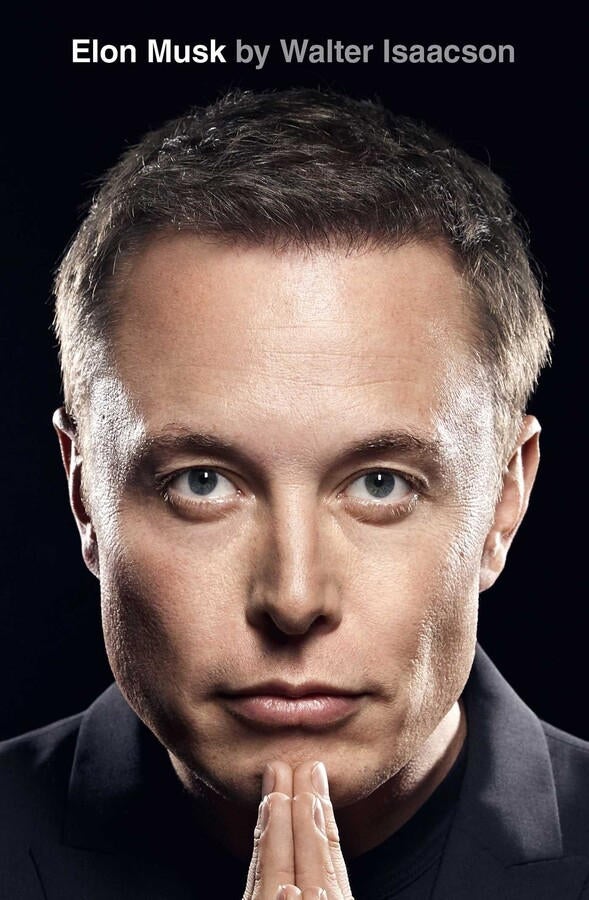
Walter Isaacson has written biographies of Ben Franklin, Albert Einstein and Steve Jobs, and this coming week CBS' sister company, Simon & Schuster, will publish his biography of Elon Musk. "You just have to say, 'I want to talk to you about Elon Musk,' and boom! People love talking," Isaacson said.
Simon & Schuster
When asked what kind of access he had to Musk, he replied, "I said, 'I want to be by your side for two or three years. I want to be in every meeting.' And he said, 'Fine.'"
As far as what Musk is like, Isaacson said, "There's no single Elon Musk. He has many personalities. Almost multiple personalities. And you can watch him go from being very giddy and funny, to being deeply in engineering mode. And then, suddenly the dark cloud happens. It's almost like Dr. Jekyll and Mr. Hyde."
Isaacson writes that Musk's volatility stems from a brutal childhood in South Africa, with his abusive father, Errol. "Everything is related to the traumas and the drives of childhood," he said. "It made him adventurous. It made him so that he felt more comfortable with drama."
Musk himself said, in a 2022 TED Talk, "I did not have a happy childhood, to be frank. It was quite rough."
"It has left deep scars on him, the way his father treated him," said Isaacson. "When he was bullied on the schoolyard, when his face was pounded into the concrete steps, and his father took the side of the person who beat him up instead of Elon. Errol Musk said, 'I raised him to be tough.' So, Errol Musk doesn't make a whole lot of apologies."
By age 31, Musk had founded and sold two software companies, making him a multimillionaire. One of them was PayPal. With that money, he founded SpaceX.
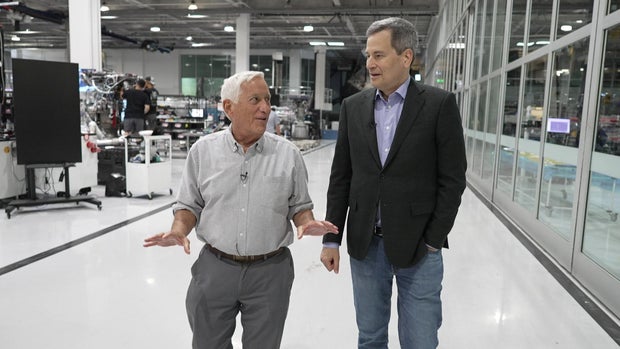
Isaacson says the SpaceX factory floor is not like, say, Boeing's: "Everybody here is willing to take risks, and they know how to move fast. When Musk and I would walk along this corridor and he would see people being a bit lethargic, or not enough people, he'd say, 'Where's everybody? Get this moving! This needs to be done by tonight!' That would never happen in Boeing."
And why the urgency? "He feels there's an urgency for humans to become multi-planetary, to get to Mars," Isaacson said. "He feels there could be a crisis on Earth, or something could happen, and we need to be a multi-planetary species."
Pogue said, "If you're the employee, your blood has gotta run cold when he comes by your station."
"You know, there are people who really try to avoid eye contact, because he can be brutal," Isaacson said. "He can get really mad. He can unload on people."
Biographer Walter Isaacson, with correspondent David Pogue on the SpaceX factory floor. CBS News
Musk is open about his Asperger's syndrome, but he believes that expressing empathy with his employees will only slow things down. As Isaacson explained, "He'd say to me, 'Yeah, I don't have as much empathy. I'm not like you, I don't want the person in front of me just to love me. I gotta get this mission done.'"
If anyone's learned how to get along with Musk, it's design chief Franz von Holzhausen. He's been at Tesla for 15 years, shaping every Tesla model, including the radically designed, stainless steel Cybertruck. "Sometimes it's not easy. You have to put some personal things aside, but ultimately the reward's worth it," he said.
Pogue asked, "Let's say I'm Elon, and I'm saying, 'We have to do it this way.' And you, based on your entire career and wisdom, disagree?"
"Those moments, you agree to disagree," von Holzhausen said. "But ultimately it's Elon's company. He's the boss."
These days, SpaceX and Tesla aren't Musk's only projects. There's his brain-implant company, Neuralink; a tunnelling operation, The Boring Company; Tesla's solar-roof division; and a new artificial-intelligence company, xAI. Tesla is also developing Tesla Bot, a humanoid robot designed to do our dirty work for us.
And then there's Starlink, a constellation of 5,000 satellites that can bring an internet signal to the entire planet, including to remote regions and disaster areas.
Last year, Musk shipped thousands of Starlink terminals to help the Ukrainian military at no charge. But when he believed that Ukraine was going on the offensive, attacking Russian ships in Crimea last September, Isaacson says that Musk shut off their service there. "Musk felt that would lead to World War III," Isaacson said, "and so, on his own, he decommissioned Starlink along the Crimean coast."
In fact, as Isaacson has now acknowledged, that's not quite what happened. Starlink wasn't running in that region in the first place, but when Ukraine asked for service there, Musk did decline to activate it.
Pogue asked, "How does Elon feel about having this much global power?"
"You know, he says to me, 'How am I in the middle of this?'" Isaacson replied. "But frankly, he loves it. He loves drama. He loves being the epic hero. I think it is a little bit dangerous, because he loves it too much."
Huh? "He loves the letter X," Isaacson said. "It's mysterious to him. There's SpaceX. There was X.com, his first payments company, that becomes PayPal. His son has a name that looks like a Druid auto-generated password [X Æ A-12 Musk], but they call him X."
Musk has had 11 children with three women. Isaacson's book reveals that Musk's ex-girlfriend, musician Claire Boucher, whose stage name is Grimes, had a new baby boy last year. His full name is Techno Mechanicus Musk.
Isaacson said, "If you ask him what the biggest problem facing America these days is, [he'll say] that we're too risk-averse, we have too many referees and not enough doers, and that's why we don't build high-speed trains or rockets that can get to orbit."
Already, the U.S. government hires SpaceX to carry our astronauts into orbit; contracts with Starlink to connect our military; and plans to pay Tesla to open its network of electric-car charging stations to all drivers.
But in a recent New Yorker article, journalist Ronan Farrow writes that the U.S. is becoming dependent on Musk even as he's becoming more erratic. Farrow notes in his article that members of the Tesla board had expressed concern about Musk's use of the prescription sleep aid Ambien, and also that Musk has not disputed he uses ketamine.
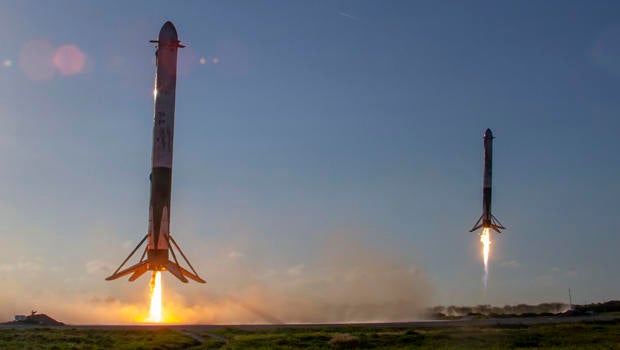
But whatever his eccentricities, Elon Musk really has changed the world. Tesla's success triggered a global shift to electric cars, and SpaceX has now conducted 261 successful launches in a row for a fraction of the traditional cost to taxpayers, in large part, because the company figured out how to land its boosters after each launch and reuse them.
After helping launch the Falcon Heavy, its twin side booster rockets detach and then land upright near Cape Canaveral, April 11, 2019.SpaceX
When asked if he admires Musk, Isaacson replied, "A biographer has to show the light and the dark strands. And you've got to be critical of the dark strands, you've got to be admiring of the light strands. But then the toughest thing is to show how they intertwine."
"And how about his legacy?" asked Pogue. "Do you think we'll be talking about Elon Musk a hundred years after he's gone?"
"He brought us into the era of electric vehicles when GM and Ford had given up," Isaacson said. "He said, 'Yes, we can shoot astronauts into orbit,' when NASA had decommissioned the space shuttle. So, a hundred years from now, we'll still be baffled in some ways about how dark he could be, but we'll say, 'Yeah, yeah. He put his finger on the surface of history, and the ripples came out.'"
David Pogue is a six-time Emmy winner for his stories on "CBS Sunday Morning," where he's been a correspondent since 2002. He's also a New York Times bestselling author, a five-time TED speaker, and host of 20 NOVA science specials on PBS. For 13 years, he wrote a New York Times tech column every week — and for 10 years, a Scientific American column every month.
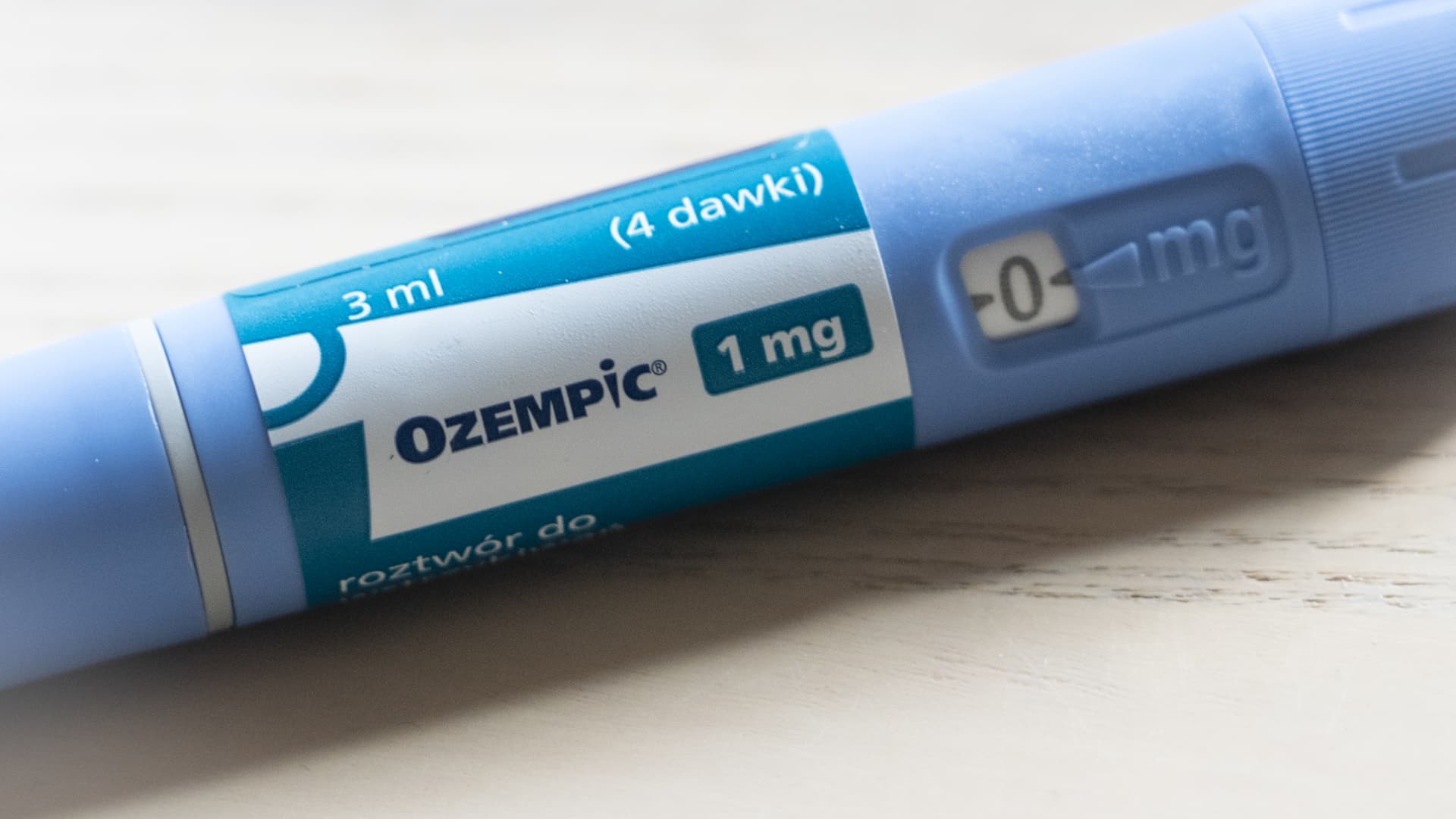
An Ozempic (semaglutide) injection pen is seen on a kitchen table in Riga, Latvia on 06 August, 2023.
Jaap Arriens | Nurphoto | Getty Images
Heather Le Biller shed 9 pounds within the first week of taking Novo Nordisk's blockbuster diabetes drug Ozempic – and then even more as she continued treatment.
Le Biller, a flight attendant who lives in France, noticed her appetite quiet down while taking the weekly injection. But so did her cravings for wine, a drink she called "almost customary to pair with every dinner" in France.
"When I was on Ozempic, it made me not want that as much anymore," Le Biller told CNBC. "I could have a few sips of wine and just be satisfied and move on. I didn't need multiple glasses a night, so it definitely seems to help with that."
Le Biller is among several patients who took diabetes and weight loss drugs and also noticed an effect on their cravings for alcohol, nicotine, opioids or even some compulsive behaviors, such as online shopping and gambling.
Those drugs – including Ozempic and its weight loss counterpart from Novo Nordisk, Wegovy – are called GLP-1 agonists, which mimic a hormone produced in the gut to suppress a person's appetite.
These anecdotal reports add to the growing list of potential benefits of GLP-1s beyond shedding unwanted pounds. Dramatic weight loss is the primary reason why those drugs have skyrocketed in popularity in the U.S., despite the fact that they can cost around $1,000 a month and some health insurers have stopped covering them altogether.
"We're prescribing these drugs and seeing this effect as a secondary benefit in patients. One of my patients even said they're not doing as much online shopping, which is helping their wallet," said Dr. Angela Fitch, an obesity medicine physician and president of the Obesity Medicine Association. That group is the largest organization of physicians, nurse practitioners and other health-care providers dedicated to treating obesity.
A customer drinks a glass of wine at the It's Italian Cucina restaurant on April 05, 2023 in Austin, Texas. A new analysis of more than 40 years of accumulated research has found that moderate drinking has no health benefits.
Brandon Bell | Getty Images
This striking effect of GLP-1s isn't a new idea. Several studies have demonstrated that certain GLP-1s curb alcohol intake in rodents and monkeys.
More research needs to be done, particularly on humans, to prove that the drugs have that effect. That means it could take years before the Food and Drug Administration and other regulators worldwide approve drugs like Ozempic and Wegovy as addiction treatments.
Novo Nordisk told CNBC in a statement that they aren't pursuing that research.
"Pharma has this general lack of interest in investing in the addiction field" due to a perfect storm of factors, including the high stigma around addiction disorders among doctors, physicians and even patients, according to Dr. Lorenzo Leggio, clinical director of the National Institute on Drug Abuse, or NIDA.
Leggio and other scientists are working to fill the gap – and have already made strides toward confirming the potential of GLP-1s as addiction treatments.
What do we know so far?
Scientists have published nearly a dozen studies showing how GLP-1s stop binge drinking in rats and mice, reduce their desire for alcohol, prevent relapse in addicted animals and decrease alcohol consumption overall.
Earlier studies have examined older, less potent GLP-1s such as exenatide, a drug approved for diabetes under the names Byetta and Bydureon.
But more recent studies on semaglutide – the generic name for Ozempic and Wegovy – and another drug from Eli Lilly called dulaglutide "are the most promising" because they reduced alcohol intake in animals by 60% to 80%, according to pharmacologist Elisabet Jerlhag.
Studies have also shown that rats that stop taking dulaglutide, which is approved for diabetes under the name Trulicity, "take weeks before they start drinking again," she said.
Jerlhag and her colleagues at the University of Gothenburg in Sweden have studied the effect of GLP-1s on addictive behaviors for more than a decade.
Boxes of the drug trulicity, made by Eli Lilly and Company, sit on a counter at a pharmacy in Provo, Utah, January 9, 2020.
George Frey | Reuters
Other studies on animals have also found that GLP-1 drugs reduce the consumption of nicotine, cocaine, heroin and amphetamines.
Few studies have been done on humans, but six clinical trials are now underway investigating how semaglutide may alter people's drinking and smoking habits.
The reason behind this anti-addiction effect of GLP-1s is that those drugs also affect the brain, not just the gut, according to NIDA's Leggio.
"The mechanism in the brain that regulates overeating is important in regulating addictive behaviors as well," Leggio told CNBC. "There is a clear shared overlap. So it's possible that the medications may help people with addiction by acting on that specific mechanism."
GLP-1s specifically decrease the amount of dopamine the brain releases after people indulge in behaviors like drinking, smoking or even eating a sweet dessert, according to Dr. Steven Batash, a gastroenterologist who provides nonsurgical weight loss procedures in Queens, New York.
Batash said dopamine is a neurotransmitter that "reinforces the pleasure" of doing those activities. When GLP-1s take away that pleasure, they also eliminate the motivation to do those activities.
What needs more research?
Still, NIDA's Leggio advises against using GLP-1s off-label to reduce addictive behaviors, "simply because there's not enough evidence in humans that they work."
"The animal studies are very promising and what people are reporting is very, very important, but as a scientist, I will also tell you that that's not enough," he told CNBC.
Leggio said scientists need to conduct more double-blind, randomized, placebo-controlled studies on humans – or trials where both participants and researchers don't know who is getting randomly selected to receive a placebo or an actual drug. Those types of studies are "the gold standard" for proving whether a treatment achieves a certain effect or not, he added
But even if those trials confirm that GLP-1s can reduce addictive behaviors in humans, "it will most likely work for some patients and not others," according to Leggio.
"We already know, as a matter of fact, that these medications and any drug overall do not work for everybody," he said.
The Good Brigade | Digitalvision | Getty Images
For example, the only clinical study in this area investigated whether exenatide could treat alcohol use disorder in people, as compared with cognitive behavioral therapy.
But a subgroup analysis of that 2022 study found that exenatide reduced drinking in a subgroup of participants who had obesity, while the drug actually increased drinking in people who didn't.
The reason may be that "leaner patients" treated with exenatide experienced a larger decrease in blood sugar, which might be associated with increased cravings for alcohol, the researchers wrote in the study.
But even that hypothesis needs to be confirmed with further research.
It's also unclear how long the anti-addiction effect of GLP-1s will last. That's already one complaint patients have when it comes to weight loss: People who lose weight after taking Ozempic or Wegovy tend to gain most of it – or even more – back within a few years.
"It's possible that some people will relapse and go back to heavy drinking if they stopped taking the medication," Leggio said. He added that some patients will need constant treatment because addiction is a chronic disease.
However, Leggio said there's "nothing wrong" with a patient seeking GLP-1s to treat diabetes or obesity, in addition to an addiction disorder.
"If you want to see whether Ozempic will help you better control the sugar in your blood but also help you with your drinking, that's wonderful. Killing two birds with one stone," Leggio said. "But if the only reason you want to take the drug is because of your alcohol or smoking, then you should wait for more evidence."
It may take years, but scientists and other health experts hope that a new class of treatments for alcohol use disorder, smoking and other addictive behaviors is on the horizon.
"It may be that three, four or five years from now, you and I are going to say that GLP-1 agonists are wonderful for treating mild diabetes, wonderful for weight loss, and perhaps we will also say that they are wonderful for curbing addictive behaviors," Batash told CNBC.
But even if GLP-1s get approved to treat addiction, it's unclear how many people would take them. Uptake of existing medications for addiction is already low.
About 14 million American adults had alcohol use disorder – a disease associated with uncontrolled drinking – in the past year as of 2019. But only 1.6% used any of the three FDA-approved drugs for the condition.
During your trial you will have complete digital access to FT.com with everything in both of our Standard Digital and Premium Digital packages.
Standard Digital includes access to a wealth of global news, analysis and expert opinion. Premium Digital includes access to our premier business column, Lex, as well as 15 curated newsletters covering key business themes with original, in-depth reporting. For a full comparison of Standard and Premium Digital, click here.
Change the plan you will roll onto at any time during your trial by visiting the “Settings & Account” section.
What happens at the end of my trial?
If you do nothing, you will be auto-enrolled in our premium digital monthly subscription plan and retain complete access for 65 € per month.
For cost savings, you can change your plan at any time online in the “Settings & Account” section. If you’d like to retain your premium access and save 20%, you can opt to pay annually at the end of the trial.
You may also opt to downgrade to Standard Digital, a robust journalistic offering that fulfils many user’s needs. Compare Standard and Premium Digital here.
Any changes made can be done at any time and will become effective at the end of the trial period, allowing you to retain full access for 4 weeks, even if you downgrade or cancel.
When can I cancel?
You may change or cancel your subscription or trial at any time online. Simply log into Settings & Account and select "Cancel" on the right-hand side.
You can still enjoy your subscription until the end of your current billing period.
What forms of payment can I use?
We support credit card, debit card and PayPal payments.
The Kroger supermarket chain's headquarters is shown in Cincinnati, Ohio.
Lisa Baertlein | Reuters
Kroger on Friday said it has agreed to pay $1.2 billion to U.S. states, local governments and Native American tribes to settle the majority of claims that it fueled the opioid epidemic through lax oversight of its pill sales.
The settlement would allow for "full resolution" of all claims on behalf of those parties, the company said in a release ahead of its fiscal second-quarter earnings. Kroger is now the latest retail pharmacy chain to announce a nationwide settlement agreement after Walgreens, CVS and Walmart did last fall.
Still, Kroger said the settlement is not an admission of wrongdoing or liability.
"Kroger will continue to vigorously defend against any other claims and lawsuits relating to opioids that the final agreement does not resolve," the company said in the release.
Shares of Kroger were up 4% in early trading Friday.
Kroger will pay $1.2 billion to U.S. states and local governments and $36 million to Native American tribes over 11 years. The company posted a net loss for the second quarter as it took a $1.4 billion charge related to the settlements and associated legal fees.
State and local governments have filed thousands of lawsuits against drug companies and wholesalers accused of contributing to the oversupply of prescription drugs that fueled the opioid epidemic, resulting in a plethora of settlement deals.
More than 564,000 people died from overdoses involving any opioid, including prescription and illicit opioids, from 1999 to 2020, according to the latest data from the Centers for Disease Control and Prevention.
Most deaths initially involved prescription drugs. Governments, doctors and companies took steps to make them harder to abuse and obtain, but people with opioid use disorder increasingly switched to heroin, which proved to be more deadly.
Several companies announced nationwide opioid settlements within the last year.
In November, Walgreens agreed to pay $4.95 billion to U.S. states, local governments and tribes to resolve all opioid claims. The company also settled with West Virginia, which had the highest number of opioid-related overdose deaths nationwide, in January for $83 million.
Also in November, CVS agreed to pay $5 billion to states, local governments and tribes to resolve all opioid-related lawsuits. The retail pharmacy also settled with West Virginia for $82.5 million last fall.
Walmart in December finalized a $3.1 billion nationwide settlement agreement with all U.S. states and local governments to resolve all opioid-related lawsuits. Walmart settled with West Virginia for $65 million a few months earlier.
Rite Aid has not reached any nationwide opioid settlement, but the company agreed to pay $30 million to West Virginia last fall. Rite Aid is reportedly preparing to file for bankruptcy within a few weeks to help restructure its debt and potentially halt ongoing opioid lawsuits.